The camera sensor (ov5640) connected over i2c but never produces a single valid frame across every software configuration tried — different clock speeds, wifi on/off, different buffer/grab-mode settings, cable reseat, usb port swap, and connector re-lock. that combination (i2c control works, parallel image-data path never does) points to a physical fault in the ribbon cable, connector, or sensor.
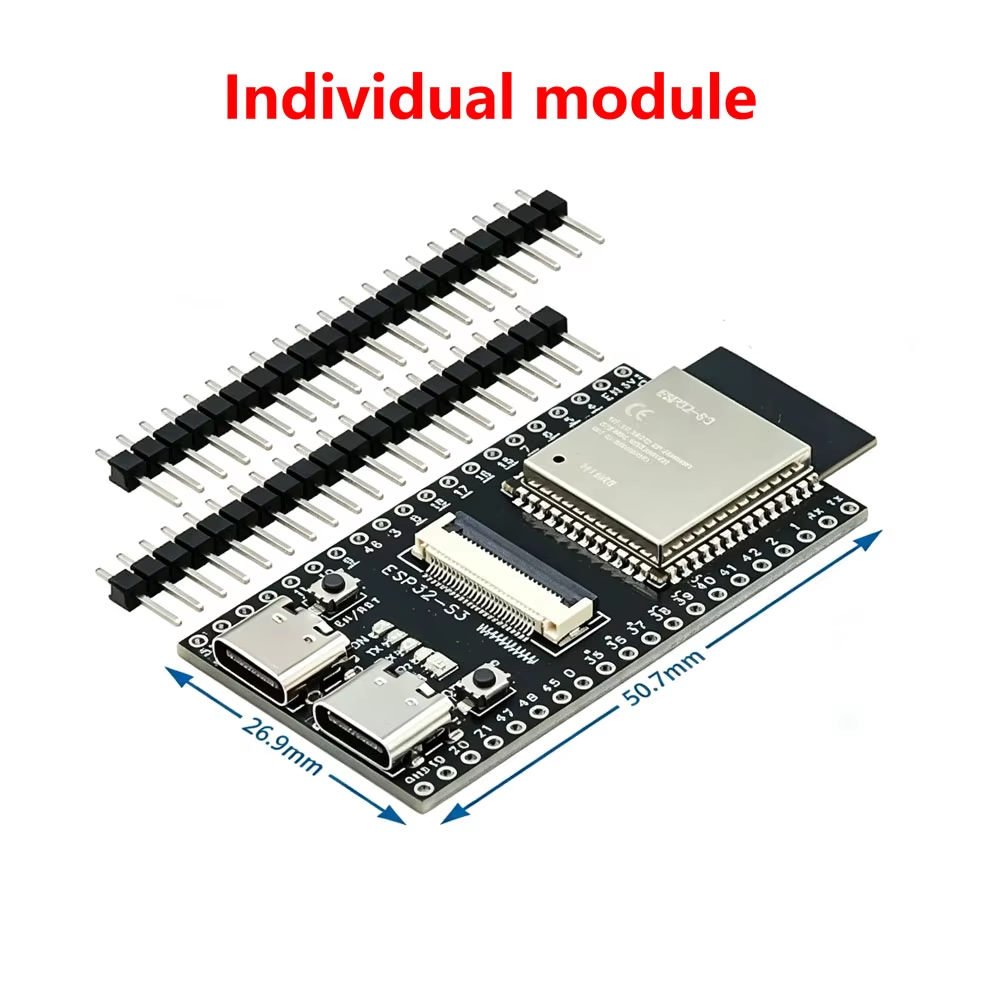
ESP32-S3 CAM WiFi Bluetooth Board with Optional Camera
ESP32-S3 CAM board featuring dual Wi-Fi and Bluetooth 5.0, Xtensa dual-core 240 MHz CPU, 8MB PSRAM, and support for OV2640/OV5640/OV3660 cameras.
Seamless Dual-Mode Wireless Connectivity
The ESP32-S3 CAM development board offers integrated Wi-Fi (IEEE 802.11 b/g/n) and Bluetooth Low Energy 5.0 mesh, operating on the 2.4 GHz band with data rates up to 150 Mbps. Both wireless functions share the same antenna to simplify design and ensure reliable connectivity.
Robust Processing Power and Memory
Powered by an Xtensa® dual-core 32-bit LX7 CPU running up to 240 MHz, this board features 384 KB ROM, 512 KB SRAM, 16 KB RTC SRAM, and a large 8 MB PSRAM. This architecture supports complex algorithms, multitasking, and data-intensive applications ideal for IoT gateways and multimedia projects.
Comprehensive Peripheral Interfaces
Equipped with 45 GPIOs and a suite of digital and analog interfaces to connect sensors, displays, and communication modules with ease.
- 4×SPI, 3×UART, 2×I2C, 2×I2S
- 1×USB OTG and USB Serial/JTAG Controller
- 1×LCD interface supporting RGB/8080/MOTO6800
- 1×DVP camera interface (8-16 bit) for camera modules
Wide Camera Module Compatibility
Supports optional OV2640, OV5640, and OV3660 cameras, enabling image capture and machine vision applications.
Hardware security ensures protected image processing.
Industrial-Grade Durability and Compact Size
Designed to operate within -40°C to 65°C, suitable for indoor, outdoor, industrial, and automotive electronics.
Compact footprint of 57 mm × 28 mm with onboard PCB antenna for strong RF performance and anti-interference.
Advanced Features for Professional Use
Includes antenna diversity, 802.11mc FTM support, external power amplifier compatibility, and multiple advertising extensions.
Additional controllers include DMA (5 RX/5 TX channels), TWAI (CAN 2.0 compatible), LED PWM (up to 8 channels), and capacitive sensing GPIOs.
Key Specifications
- CPU: Xtensa® Dual-Core 32-Bit LX7, 240 MHz
- Memory: 384 KB ROM, 512 KB SRAM, 16 KB RTC SRAM, 8 MB PSRAM
- Wireless: Wi-Fi b/g/n (2.4 GHz, up to 150 Mbps), Bluetooth LE 5.0
- GPIOs: 45 general purpose I/Os
- Interfaces: SPI, UART, I2C, I2S, LCD, DVP camera, USB OTG
- Operating Voltage: 3V to 3.6V
- Operating Temperature: -40°C to 65°C
- Dimensions: 57mm × 28mm
What's in the box
- ESP32-S3 CAM WiFi Bluetooth Development Board
Frequently asked questions
01 What wireless technologies does the ESP32-S3 CAM support?
It supports Wi-Fi IEEE 802.11 b/g/n (2.4 GHz) up to 150 Mbps and Bluetooth Low Energy 5.0 including mesh networking.
02 Which cameras are compatible with this development board?
The board supports optional OV2640, OV5640, and OV3660 camera modules for image capture projects.
03 What processor powers the ESP32-S3 CAM board?
It uses an Xtensa® dual-core 32-bit LX7 CPU running up to 240 MHz.
04 How much memory does the board include?
It features 384 KB ROM, 512 KB SRAM, 16 KB RTC SRAM, and 8 MB PSRAM.
05 What are the general I/O and peripheral interfaces available?
The board offers 45 GPIOs, 4 SPI, 3 UART, 2 I2C, 2 I2S, USB OTG, LCD interface, DVP camera interface, and more.
06 What power supply voltage does the board require?
The operating voltage range is between 3V and 3.6V.
07 What is the operating temperature range of the ESP32-S3 CAM?
It operates between -40°C and 65°C, suitable for industrial and automotive environments.
08 Does the board include any security features?
Yes, it integrates hardware security mechanisms to meet strict security requirements.
09 What are some advanced features of this board?
It supports antenna diversity, 802.11mc FTM, external power amplifier, multiple advertisement sets, DMA controller, CAN bus controller, LED PWM, and capacitive sensing GPIOs.
10 What are typical applications for this development board?
It’s ideal for IoT devices, smart home appliances, wearable tech, industrial control, automotive electronics, wireless sensors, camera modules, media players, and embedded projects.
Discussion
Very normal Esp32 S3, great product, I would definitely order it again.